








|
|
|
|
|
|
|
|
|
|
|
|
||||||||
|
|
|
|
|
|
|
|
|
|
|
|
|
|||||||
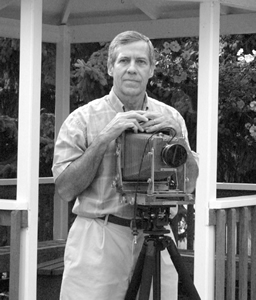
I became interested in photography at an early age when I was given a Kodak Brownie Box Camera. I still have most of those early negatives saved!
As a teenager, I built a darkroom under the stairs and did contact printing with a naked bulb as the light source. At University, I joined the camera club and used an enlarger for the first time.
In 1973, I came to Calgary and was introduced to black and white fine art photography by Dr. Harry Thomson. I thought this was wonderful and bought a Mamiya RB67 camera, but within a year I switched to a 4x5 view camera. I started exploring digital photography in 2008 and currently use a Canon 60D for most of my work. Although I have stopped working in the wet darkroom, I now scan my 4 x 5 negatives into digital files, and then print them digitally.
With Harry's encouragement, I attended workshops run by prominent photographers that included Bruce Barnbaum, Paul Caponigro and Michael Kenna. I attended the very last workshop run by Ansel Adams at Yosemite and I met Alan Ross and John Sexton there. I have attended three workshops with John Sexton and he continues to be an inspiration to me. In 2008 I attended a workshop run by Brooks Jensen and was introduced to digital photography. I was so impressed with this that I am now working only digitally.
I enjoy looking at fine photography but especially black white prints. Capturing light is at the centre of photography so it is important that the quality of the light exudes from the print if it is to capture the attention of the viewer. There is a great deal of technique involved in the photographic process, but in the end it is the print that must make the statement so technique takes second place to this. The production of a truly expressive print only occurs when the mind and the heart are involved.
My special interest has been landscape photography, no doubt influenced by my exposure to many fine West Coast photographers, but I am now leaning toward being more intimate with the landscape and now prefer to focus in on the fine details within the big scene. I also enjoy the challenge of architectural photography and, thanks to Brooks Jensen I am now becoming more involved in special projects. The first special project I did was on the Britannia Heritage Shipyard in Steveston in Richmond B.C. This was done with my 4x5 view camera. My first digital project was that of Frost Abstractions. I submitted it to LensWork, a prestigious photographic magazine, and I was one of 14 photographers chosen for the Year End Gallery in 2009. In 2009 I started a project called “New Picture of the Week” which ran for 52 weeks. I enjoyed this very much and it was well received. An exhibition of some of my work was held at the Glenrose Rehabilitation Hospital in Edmonton in May and June of 2010. Other projects I have worked on include, A Day in Havana, and Botanical Portraits.
For many years my primary camera was a 4x5 Wisner Field Camera, but now it is a Canon 60D. I work with both Lightroom and Photoshop CS5. I scan my old 4x5 negatives using an Epson Perfection V700 scanner, and print on an Epson Stylus Pro 3880. My paper of choice is Epson Exhibition Fiber Paper, but I also use Hahmemuhle Fine Art Baryta Paper. Both of these papers have a textured surface and are almost indistinguishable from each other. Although I still print most of my photographs in Black and White, every so often a picture seems to be more expressive in colour and then I will print it in colour.